Little House in the City

Little House in the City

Monday, March 4, 2013

Spring chickens

The girls.  

I cannot wait until spring, when we can spend more time with the girls again.  

I want to pin clothes on the line to dry,  I want to shellac the picnic table, and I want to hang out with my chickens. 


I am, apparently, a simple creature.


I am also a bit end-of-winter-cabin-fevered, and we are supposed to get some enormous and much-hyped amount of snow and nasty weather tomorrow.  [Which reminds me. Welcome to my annual battle of wills with late winter:  I may win in the end, but it is usually too close to call during late Feb-early March.  I most always suffer a complete--if temporary--reversal at some point before April arrives.] 

But the chickens are quite sure that spring is here.  Almost overnight everyone perked up, and now combs are bright red, feathers are shiny, and it is time to get out in the yard and patrol the premises. 


Suddenly, eggs are everywhere.  Roxie's laying again and refuses to use the nest box, so there is usually a pale blue egg in the straw underneath it.  Then again, Jason found her recently sitting half out of the box on Ethel, who was squished entirely in the box, so maybe Roxanne is just looking for trouble.  Some of the girls are having fun occasionally using the outside nest box, too, which I keep forgetting to check after no one touched it for months. 


When all of this chicken exuberance appeared, I had a moment of bliss:  Spring really is around the corner.  The girls know; they are my own little assurance.  

I remember one sheltered courtyard on my Minnesota college campus, where a tiny forest of crocus bloomed each spring long before any other area had lost snowcover.  It was a miracle each time.  Turn the corner, look down and--color!  Green leaves, gold and purple flowers.  Hallelujah, winter's lost!


Well, we've got some additional colors to add to the hallelujah 'round here.  Richly orangey-yellow egg yolks, and all shades of brown, black, silver, tan, and deep-red feathered hens.  There are green tips of garlic and daffodils up as well, and the dark brown of the earth is richer and wet with the thaw. 


Mmmm.

Almost here.   

Sunday, February 10, 2013

Our strange ways

It occurs to me it might be time to revisit how we are doing with some of the weirder embargoes and substitutions around the house that we've adopted in our attempt to live a more sustainable--and frugal--life.

This thought came to me as I was cooking bacon just now.

If you fail to see the connection, then you have never lived in a household with a rule against purchasing paper towels.

I should make one distinction clear:  there is probably a really nifty product out there designed to drain bacon without paper--perhaps a platter with a grill pattern that drains the grease away, or something.  However, my purpose isn't to justify purchasing a bunch of "green" products designed to solve the given problem.  Reusable or not, I believe that we are too easily seduced into buying the next clever environmentally-friendly product.  I say this, not in judgement, but as a fellow perpetrator--believe you me, I could spend our combined incomes in a hot second on any number of websites and catalogs geared toward the green consumer.

But the truth is that anything new has an enormous manufacturing legacy of materials, fuel, and and often cruel labor choices behind it; no matter how many recycling triangles and super-duper green endorsements are on the packaging (the packaging!), it would still have been better, ecologically speaking, to get a used version at a thrift store or make your own out of re-purposed items.

So.  The paper towels.  What do we use instead?


Handsome, but occasionally vomits.
Well, we realized pretty quickly that we use paper towels for three main things:  draining bacon, mopping spills, and cleaning up cat puke.  (Yep.  Just took you from mouth-watering to gagging in one sentence.  Mad skills, I tell ya.)  You might add cleaning windows and mirrors to the list, I suppose, but I can't think of much else.  If you are still using paper towels to wipe down your counters in the kitchen, then please, consider the beauty of a...

...(drumroll, please)...

Rag.

A rag.  A rag is a beautiful thing, simply because it can be made of so many, many other things most of which you would otherwise throw away.  Under duress, I will admit to a bit o' pride in the cardboard box of rags in my laundry room.  It is satisfying to always have one when you need one.  I realize this is weird.

Sock have a hole in the toe?  --Rag.  Grease stain on your skirt?  --Rag.  Almost any item of cotton clothing can be used in place of paper towels.  Cut them up into 12" squares, and there you go.  If you want to get really fancy, you can mix up some cleaning solution out of castile soap, white vinegar or lemon juice, and water, put it in a lidded bucket, and use it to store your rags--just wring one out and clean what ails you.  Old towels are perfect for bigger spills, and cotton jersey works nicely on windows and mirrors too.

But back to my bacon.


I have two substitutes for paper when I want to drain bacon.  First, is a square of fabric from an old t-shirt.  Between uses, I suds it up with dishwashing detergent (which cuts grease better than regular soap), rinse, and let it air dry.  Not all of the grease is removed but enough for my comfort level; we probably use the same cloth over a period of 4-6 months or more before I throw it away.

If you aren't comfortable reusing a cloth like that, then why not at least give a second life to paper grocery bags that are likely lurking under your kitchen sink?  A plate-sized square of brown paper drains bacon too--and if you are feeling particularly virtuous, save the greasy paper and use it the next time you start a cozy fire in the fireplace. (Consider the humble grocery bag for many things...rustic gift wrap and gift tags are another common use around here.)

[So, bacon and spills are handled with cloth rag, blah blah blah.  I mentioned cat vomit also.  Well, I draw the line there.  I refuse to reuse anything that addresses vomit--the whole situation is too gross.  I realize that this is illogical.

Instead, I use...junk mail.  Mmm hmm.  I take a credit card offer in one hand, and a stiff-papered catalog or flyer in the other, and I use the envelope to scrape up the yuck on to the flyer and then throw it all away. Then I spray the spot with cleaner and mop up any residue with a rag.  I'm sure you were dying to hear about all that.]

Used rags of all sorts tend to wait for the next washday on top of the dryer, but you might want to give them a box or bucket in which to be stored until you do laundry, just to keep things tidy. 

Ready to cut up some old shirts and towels?  Want to get really obsessed and make rugs out of them?  Perfect. 

Friday, January 4, 2013

Tis a gift to be simple...tis a gift to be free


Isn't it nice to think that tomorrow is a new day, 
with no mistakes in it yet?
 -Anne Shirley


I don't know about you, but 2012 has been a doozy of a year around here.  Good and bad, yes, but a challenge on many fronts for me.  New year's resolutions are not a tradition of mine, but somehow I am drawn to the idea a bit.  Perhaps this is a way of petitioning the universe to honor my bargain--if I start fresh, then it will too?   

I have been pondering the older, seasonal truths that make up the fabric of this time, the juxtaposition of the darkest, longest nights with our ancient faith that sun and warmth will come again.  I am fascinated by our stubbornness and the small, silent light that persists and nests defiantly in our hearts.

Christmas was good this year, filled with family that I see too infrequently.  There was a whole crop of new babies this time, snuggled little baby birds tucked here and there in the crook of an arm, alongside lots of good food and laughter.  My heart, usually so capable of absorbing it all, is tender and easily overwhelmed this year, and my eyes a bit leaky.  It is strange and poignant to hear my dad's voice when my brother sings a carol, the echo of my nephew's childish giggle when his son laughs at a joke.  It is weird and lovely and staggering to love all of these people and belong to them and accept the risks that such loving brings.

Of all the things that I didn't get around to, I was able to whip up a few goodies to give away, and my favorite of the bunch is the new recipe for hand and body cream that I've been making lately.  This recipe is from Making It: Radical Home Ec for a Post-Consumer World, and the cream is rich and luxurious.  It goes on a bit shiny but quickly absorbs.  Best of all, it has five ingredients, all of them pronounceable.

 Coconut-Vanilla Cream
6 oz olive oil
2 oz coconut oil                                                                
1 oz beeswax (grated or chopped fine preferred)                         
                                                                                                      
1 cup tepid water, filtered or distilled is best
essential oils as desired (I used a splash of vanilla extract)

Tools:  Blender or hand mixer, Mason jar, sauce pan, spatula, empty jars

Combine the oils and beeswax in a wide-mouth mason jar and set the jar in a small saucepot with several inches of water over low heat.  Stir occasionally as the beeswax melts.

Prepare a blender or deep mixing bowl by filling with boiling water to warm the container.  Have the cup of water and any essential oils mixed and ready.  Dump out the hot water and immediately pour in the hot oil mixture. Turn the blender on the lowest setting or start mixing the oil with a hand mixer.  Slowly pour the water into the middle of the oil.  The mixture will quickly turn to cream and the blender will start to rev and be unable to continue incorporating the water.  Stop the blender, scrape down the sides and mix with a spoon, then turn the blender on again.  Repeat until the mixture is smooth and the water fully incorporated.

If the cream is still liquid enough, pour into clean jars.  If not, scoop it out with a spoon.  Tamp down the jars to eliminate air bubbles.  Let cool, add labels, and enjoy!


Many delightful blessings to you and yours in the new year. 

Monday, November 12, 2012

Fall...and snippets of Summer

We've had so many warm, sunny days this fall that I've been able to sneak in a few last-minute outdoor chores and harvests that I might otherwise have missed.  Of course, as I type this, snow is falling thickly outside, so it looks like winter has arrived....
Ethel helping with the garlic
Yesterday, I finally got around to planting the garlic. I chose a bed along the western fence of our garden that I had left fallow this year, after applying a good dressing of rabbit manure in the spring.  There was some red clover growing there over the summer, along with a jungle of lambs quarters which will make a nice crop of greens in the spring when it self-seeds. 

I pulled all of the greenery and smoothed out the soil.  It is great to see the soil after three years of amendment--finally starting to resemble the rich, organic loveliness that is the goal.  Between the reliable source of rabbit manure, and the manure/bedding from the girls, my garden flourishes no matter how much I neglect it.

My plan for the bed is to plant the garlic now and then following with a planting of pole beans and/or squash vines in late spring.  Since the garlic will be ready for harvest by July, it will be out of the way for the later crops.  I plant two varieties of garlic, one that doesn't keep as long but has a soft stem that can be used to braid the bulbs together...which I love in theory and yet have never done.  *sigh*  The second variety is a great winter keeper, but the bulbs are slightly smaller and the stem is very rigid.  They both require the same growing conditions, which for today means that I need to give them fairly loose, fertile soil and a good mulching since it is so late in the season and cold is just around the corner.
Soft- and hard-neck varieties

Since the soft-neck variety doesn't keep for very long I don't plant as much of it, but plan to use it up during the summer and fall after harvesting.  Of the four rows I planted today, 2 1/2 were the winter-hardy and 1 1/2 were the soft-neck.  Then I piled several inches of bunny manure over the top and capped that with straw bedding.

A quick word about rabbit manure:  it is the one manure that is safe to put directly in your garden; it will not burn the plants like other uncomposted manures will.  It makes a nice, if stinky, mulch for taller plants because there is so much grassy bedding along with the manure pellets.  If you can find a source, definitely take advantage--check at 4H events, county fairs, etc.

I am happy to have the garlic in the ground; it is the one thing I grow in which we are self-sufficient, and I feel as though I have a standard to uphold!

Next I moved on to split up the daffodils at the end of the driveway, which for the last three years have sent up more and more leaves with fewer flowers--a sign, I assumed, that down in the soil the bulbs were dividing, multiplying, and making many smaller bulbs without enough room to flourish.  The problem, and the reason why I've been avoiding this chore, is that the daffodils come up each spring through the heavy mat of vinca and ivy that the former owners of this house planted every last place they could think of.  Arggh.

Clearing the ivy requires a ridiculous amount of sheer tugging and yanking, working through the soil with my hands to pull out roots...I already know how sore I will be tomorrow.  But the fun part was finding the little gnome-like colonies of bulbs, whiskery with roots, and separating them between my fingers.  I spaced them out and replanted them, covering the soil with a 2' x 3' piece of chickenwire to keep the squirrels out, and then topping it all with a heavy mulch of rabbit manure.  

Finally, it was time for the big event. Okay, the big event for me--which is not everyone's idea of excitement, I'll grant you.  Anyway:  echinacea root harvest!  I started these plants from seed the first spring we were here in our house, and they are just now old enough to try for roots big enough to be worthwhile. 

Roots of Echinacea purpurea
Here's the thing with herbs and healing--this is something that I've always had an interest in, no matter the guise--from traditional Chinese medicine to modern American herbalism, or within the paradigm of women, midwifery, and reproductive health.  I have no clinical studies or controlled experiments going on, but I know that over the past few years we've adapted several homemade remedies that work for us when colds come on or there are wounds to heal.

So, onto the echinacea tincture:  To get at the roots, I pushed the shovel in all around the plant and then tugged it gently up out of the ground.  I turned it over, cleaned off as much soil as I could, and snapped off the roots I wanted, and then replaced the plant in its hole, filling in around it and tamping it back into place.  I added a thick manure/bedding mulch for good measure.

I think that I could have waited another year for these plants...I've read that finger-sized roots are best, which are old enough to have developed full medicinal potency, and I didn't have as many roots that size as I'd hoped.  Of course, this wasn't exactly a summer of heavy growth for any of my unwatered native plants, so we'll see what next year brings.  I chopped up the roots into small pieces and filled a pint jar with them.   I poured 80 proof vodka over the roots, capped the jar, labelled it, and put it on the shelf to wait six weeks.  (The alcohol should be 100 proof ideally, but I used what I happened to have.)

These last warm and rainy weeks have allowed me to harvest comfrey and plantain, healing plants whether used fresh as a poultice or infused into a healing oil which can be used as is or made into lotions, creams or balms.  At this time of year, I want to preserve whatever I can because the dried versions seem to miss some essential greenness.  So I picked the wide, furry comfrey leaves that grow by my garden and the smooth green plantain leaves that grow in my lawn, let them wilt and dry for a day, and then cut them up into separate mason jars.  I poured in olive oil slowly, stirring with a stick to release air bubbles, until the oil topped the herbs with space to spare.  Now they will sit in the sunny window sill for a few weeks, slowly infusing the oil with their goodness.

I also put together a few new items and one old standby:

First, we were out of toothpaste--which is actually a peppermint tooth powder that I've been making for the past year or so out of baking soda, stevia powder, and peppermint essential oil.   I have never measured my formula, which isn't helpful, but it goes something like this:  2-3 big spoonsful of baking soda, one medium spoon of stevia, liberal sprinkling of essential oil.  Mix.  Repeat until jar is full or you've made the desired quantity.  To use, spoon a heaping portion on a wet toothbrush and brush teeth.  (Or if you get lazy about using the spoon like we do, then dip your dry toothbrush in the powder, wet with a few drops of water under the tap, and brush.)


As for the new stuff, I decided to work on a hair & scalp oil-- specifically, jojoba oil infused with rosemary, lavender, nettles, and horsetail.  Once the oil has infused for 4-6 weeks, I will add a few other essential oils such as clary sage, lemon, and patchouli, and then use this as an overnight treatment for my scalp, which gets dry at times.  All of the herbs and essential oils are ones that are either good for hair and scalp in general or for dandruff or itchy scalp.  It will smell amazing.
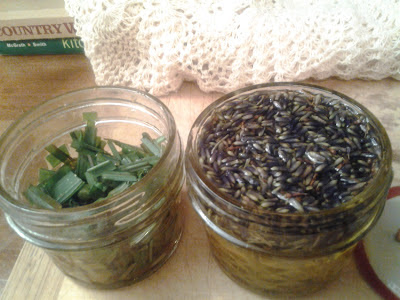
Lemongrass honey and rosemary lavender oil.  Mmmm.


Lemongrass Honey--this was a last minute idea and an easy one--I snapped off one of the thickest stems at the base of the plant I'm attempting to over-winter, chopped up the green leaves, and then peeled the dry outer leaves from around the heart of the stem, which I cut up into small rounds.  The leaves and stem pieces I put in a small jar and covered with honey.  This can steep for weeks, and will be completely wonderful in tea over the winter.

Oh and one final announcement:  I have a wonderful new addition to my office, in memory of my friend Cathy's mother, Molly Malone.  This hutch held her recipe boxes and china for over thirty years before she passed away last month--and now it holds all of my crafty herbal homesteading paraphenalia.   An apothecary hutch?  A potion cupboard?  Who knows what to call it...but thank you, Molly.  I have no doubt that you would approve of the new purpose for this lovely old piece.


Books, herbs...and room to work.


Finally, all of the herbs in jars.

Chickens, gardening, homemade cleaners--ta da!
Lemon verbena.  Best scent ever.